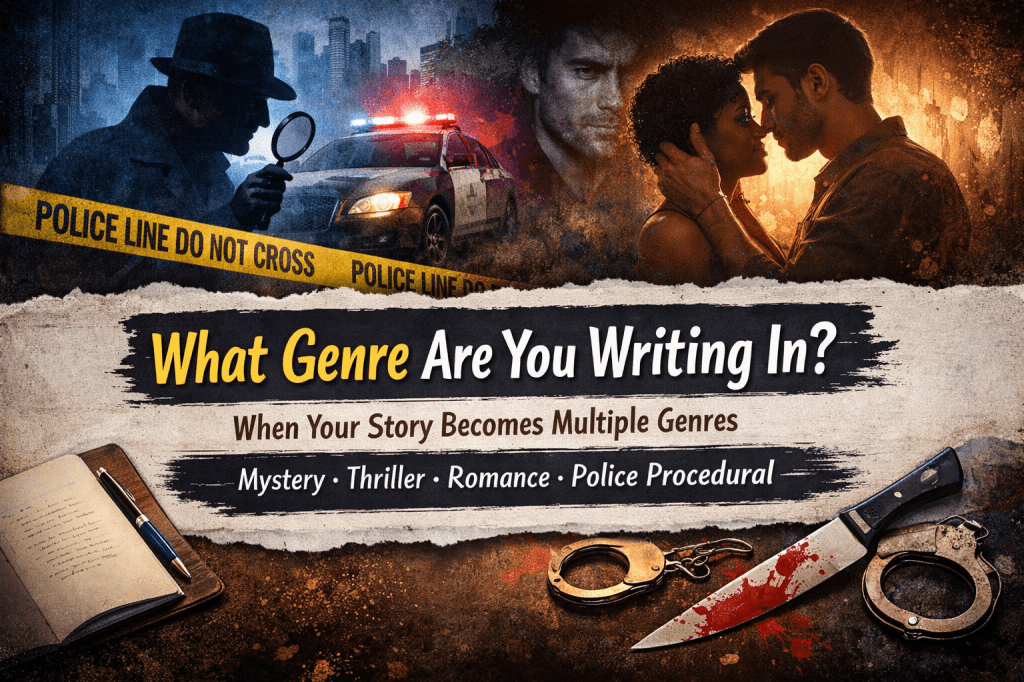
Have you ever started writing a short story or novel in one genre, only to realize later that it turned into something completely different?
This has happened to me more than once. I enjoy writing mysteries and police procedurals, but when I’m working on a story, I often find myself adding romantic elements along the way. In one of my latest drafts, I thought I was writing a mystery/police procedural. But after reading the manuscript, I realized it had become a psychological thriller, romantic suspense, and police procedural all in one.
And honestly, I enjoyed the way it turned out.
This seems to happen to me quite often. One of the works-in-progress I’m currently writing is shaping up the same way. I’ve even started going back through some of my other WIPs just to see what genres they might actually fall into.
Let the Story Decide the Genre
What I’ve realized through this process is that sometimes, as writers, we need to write the story first instead of worrying about the genre.
When you sit down to write, you won’t always know exactly what genre your story will belong to when it’s finished. Instead of trying to force your story into a specific category, focus on the elements needed to tell the story you want to tell.
Trying to force a story into a particular genre can sometimes limit where the story naturally wants to go.
For example, if I had pushed myself to write only a police procedural, I don’t think my novel would have been as effective—or even as interesting. The additional elements that developed in the story helped make it feel more real and layered. Those elements are often what help a story resonate with readers.
How Do You Know What Genre You’re Writing?
Sometimes we start writing a story thinking it belongs in one genre, only to realize later that it fits somewhere else. One thing that helped me was learning what elements define certain genres.
Here are a few examples.
Mystery
A mystery focuses on solving a crime or uncovering a secret. The story usually follows an investigator, detective, or amateur sleuth who is trying to piece together clues.
Common elements include:
- A crime or unexplained event
- Clues and red herrings
- An investigation
- A final reveal
Police Procedural
A police procedural focuses on how law enforcement investigates a crime. These stories often highlight the detailed processes police officers and detectives use to solve cases.
Common elements include:
- Police departments and detectives
- Interviews and interrogations
- Evidence collection and forensic work
- Team investigations
Romance usually isn’t the central focus in a traditional police procedural, although characters may still have personal relationships in the story.
Psychological Thriller
A psychological thriller focuses on the mental and emotional tension between characters. These stories often explore fear, manipulation, obsession, or unstable perceptions of reality.
Common elements include:
- Mind games and manipulation
- Intense emotional conflict
- Unreliable characters or perspectives
- High psychological tension
Romantic Suspense
Romantic suspense blends danger and romance. The characters are usually facing a serious threat while also developing a romantic relationship.
Common elements include:
- A romantic relationship that is central to the story
- Suspense or danger surrounding the characters
- Emotional stakes combined with external conflict
When I looked at these elements, I realized my story didn’t fit neatly into just one category. It had the investigative structure of a police procedural, the tension of a psychological thriller, and the emotional elements of romantic suspense.
And that’s when I realized that sometimes stories naturally become multi-genre stories, whether we plan it that way or not.
Write the Story That Needs to Be Written
So write the story that needs to be written—even if it crosses into multiple genres. Many readers enjoy books that blend genres. I know I do.
Don’t let the label of a genre hold you back from writing your masterpiece.
What genre did you start writing in, and did your story stay in that genre—or evolve into something else?
Leave your thoughts in the comments below.
 C. N. Garraway
Leave a comment